Maulana Abul Kalam Azad 1888 — 1958

Freedom

The Freedom Movement

Thirty-seven years inside a movement that argued with itself constantly — from the Khilafat years to Ahmednagar Fort and the last negotiations.

Joined mass politics
c. 1920
Longest imprisonment
Ahmednagar Fort, 1942–46
Chapter
05 of 08

The Indian freedom movement was not one thing. It was a long argument between people who agreed about independence and disagreed about almost everything else — method, timing, allies, and what independence was for.

Maulana Azad spent thirty-seven years inside that argument. This page follows his part in it, in sequence, with the surrounding context that makes his choices legible. It does not present the movement as a single unified march, because it was not one.

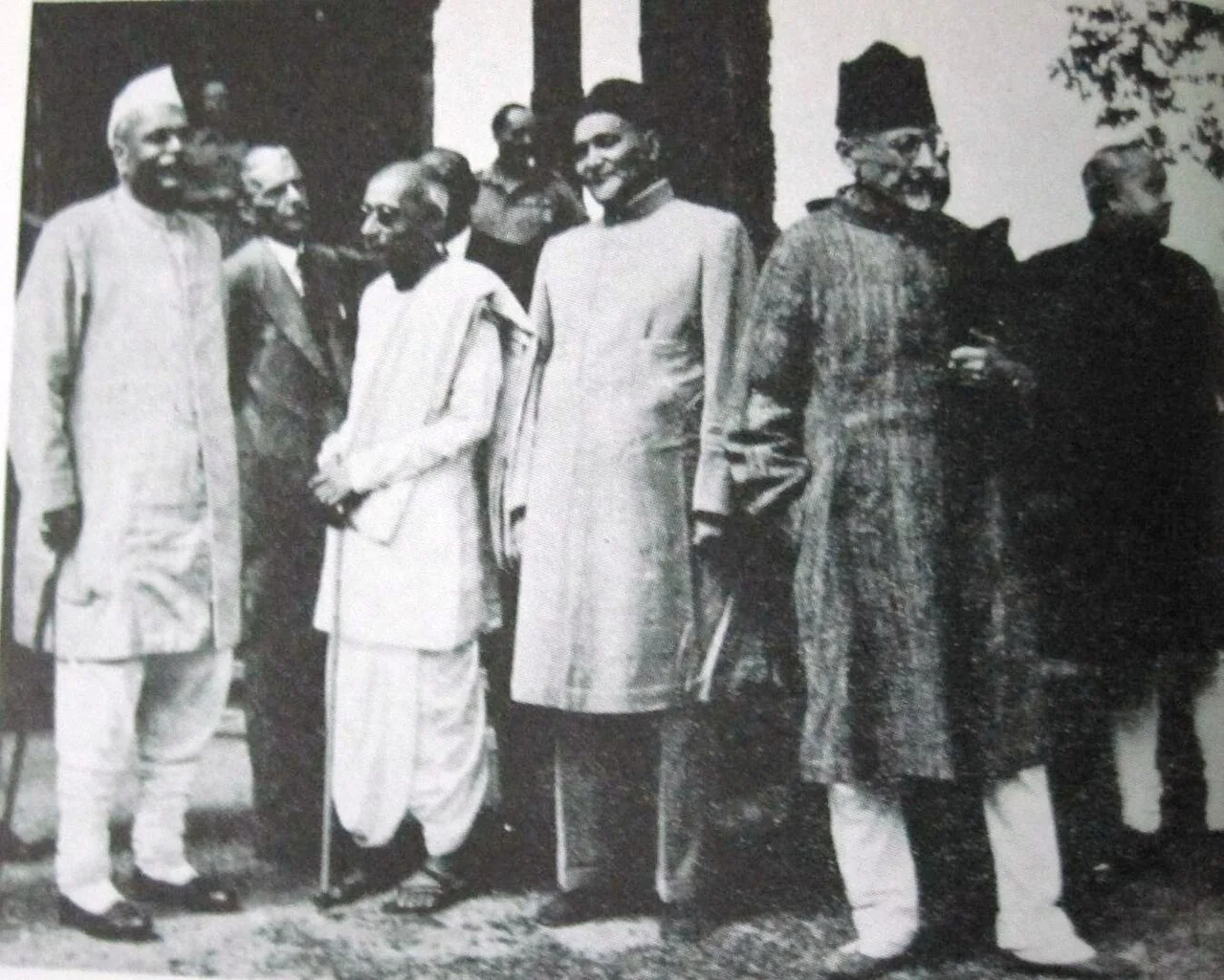
Group photograph of Indian political leaders standing outdoors during a conference at Simla, Maulana Abul Kalam Azad among them in a long coat and cap.
ArchiveIndian leaders at the Simla conference. Photograph reproduced from a printed source.
1905 – 1919

Political awakening

Azad became political in Calcutta, in the years after the 1905 partition of Bengal, when the city was the centre of Indian anti-colonial activity. Historical accounts describe him coming into contact with revolutionary nationalist circles in Bengal in this period, and travel to West Asia and Egypt brought him into contact with anti-colonial and reformist currents in the wider Muslim world.

The conclusion he drew was that the Indian political situation required organised Indian political action, and that Muslims who stood outside it were surrendering a claim on the country’s future rather than protecting themselves. From 1912, Al-Hilal made that case weekly, and from 1915 Al-Balagh continued it. Both papers were stopped. From 1916 until 1 January 1920 Azad was held under restriction and could not publish at all.
1920 – 1922

From journalism to mass politics

Azad was released at the start of 1920 into a transformed political situation. The Jallianwala Bagh massacre of April 1919 had destroyed what remained of liberal confidence in British intentions. The Khilafat agitation — concerning the position of the Ottoman Caliphate after the war — had mobilised Indian Muslims on an unprecedented scale. And Gandhi had proposed joining the two into a single non-cooperation campaign.

Azad entered that campaign and joined the Indian National Congress. In October 1920 he was a member of the foundation committee of Jamia Millia Islamia, established as a nationalist institution outside the colonial education system — an early indication of where his interests would eventually settle.

The Non-Cooperation movement was called off in early 1922 after violence at Chauri Chaura, a decision that divided the movement and disillusioned many who had joined it. The Khilafat question itself was overtaken by events in Turkey. What survived, for Azad, was the Congress connection, and it lasted the rest of his life.

1922 – 1929

Gandhi and the national movement

Azad worked closely with Gandhi from 1920 onward, though the two men came from entirely different intellectual worlds and did not agree on everything. What they shared was a conviction that the movement had to be genuinely inclusive to be legitimate, and that a nationalism defined by religious majority would produce a country neither of them wanted.

In September 1923 Azad presided over a special session of the Congress in Delhi. He was thirty-five — the youngest person to have been elected president of the organisation. The session dealt with the strategic disagreements that had followed the suspension of Non-Cooperation, in particular whether Congress members should contest elections to the colonial legislative councils.

The rest of the decade was organisational: committee work, provincial travel, argument inside a Congress that was simultaneously trying to define its programme and hold together people who wanted very different things from it.

1930 – 1939

Prison & political commitment

The Civil Disobedience movement launched in 1930 brought mass arrests, and Azad was among those imprisoned during this period. Imprisonment was, by then, a routine feature of Indian political life — which is precisely what made it effective as a tactic and gruelling as an experience.

The decade’s other development mattered more in the long run. The Government of India Act of 1935 introduced provincial autonomy, and the elections of 1937 gave Congress ministries office in most provinces. It also sharpened the question that would dominate the next ten years: what political guarantees, if any, Muslims required in a self-governing India, and whether those guarantees were compatible with a single national polity.

Azad’s answer was consistent with everything he had written since 1912. Guarantees of rights, yes; a separate political nationality, no. He would spend the following decade defending that position under conditions that grew steadily less favourable to it.

1940 – 1942

The wartime years

India was declared a belligerent in the Second World War in 1939 without consultation, and the Congress provincial ministries resigned in protest. It was in this atmosphere that the Congress met at Ramgarh in March 1940 and elected Azad its president. He would hold the office for six years — the longest and most difficult presidency in the organisation’s history.

His presidential address at Ramgarh set out his position on Indian nationality at length, and it is the text most often quoted from him today. Days later, the Muslim League met at Lahore and adopted the resolution that became the foundation of the demand for Pakistan. The two positions were now formally opposed, and the argument between them would define Indian politics for the next seven years.

“I am a Musalman and am proud of that fact … I am proud of being an Indian. I am a part of the indivisible unity that is Indian nationality.” Presidential address, Indian National Congress, Ramgarh session, 1940 — widely reproduced English translation

Wartime negotiations followed: the Cripps Mission of 1942 offered dominion status after the war with a right of provinces to opt out, and Congress rejected it. That rejection led directly to the movement of August 1942.

1942 – 1946

Quit India

On 8 August 1942 the All India Congress Committee, meeting at Gowalia Tank in Bombay, passed the Quit India resolution demanding an immediate end to British rule. Azad was the sitting president of the Congress. Within days the entire leadership was arrested; Azad was held at Ahmednagar Fort, where he remained with his colleagues until 1945.

The movement itself was suppressed with considerable force in the absence of its leaders. The imprisonment was long — nearly three years for most of those detained — and it removed the Congress leadership from public life at the precise moment when the political ground was shifting most rapidly.

Azad used the time to write. Ghubar-e-Khatir, the collection of letters composed at Ahmednagar Fort between 1942 and 1946, is now considered one of the finest works of twentieth-century Urdu prose. It is not a political book. It is a book about music, memory, language, solitude and the taste of tea, written by a man who did not know when he would be released — and it is, for that reason, a document of considerable moral seriousness.

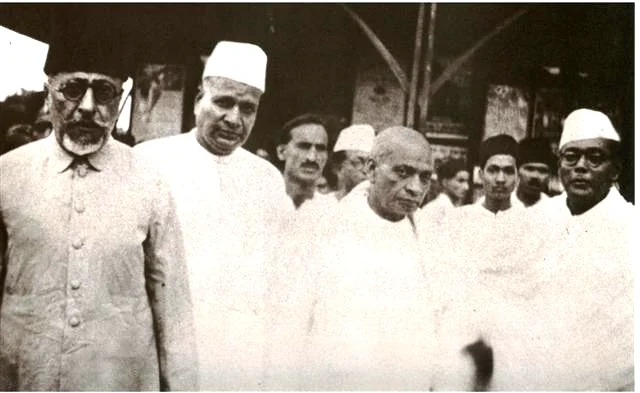
Congress leaders walking together in white khadi, Maulana Abul Kalam Azad at the left in spectacles.
ArchiveCongress leaders, Azad at left. Occasion not recorded in the available source.
1945 – 1947

The last negotiations

Released in 1945, Azad led the Congress delegation in the negotiations that followed. The Simla conference of 1945 failed over the question of who could nominate Muslim representatives. The Cabinet Mission of 1946 proposed a federal settlement with grouped provinces — a structure designed to keep India united while giving Muslim-majority provinces substantial autonomy. Azad supported the 16 May proposal.

The plan collapsed. What followed — the deterioration of public order through late 1946, the arrival of a final British deadline, and the acceptance of a partition plan in June 1947 — is the subject of the next chapter of this site.

Azad ceased to be Congress president in 1946. He entered the Constituent Assembly in November of that year, and on 15 August 1947 became independent India’s first Minister of Education.

A note on complexity The Indian freedom movement contained several movements with different aims, methods and constituencies, and its participants disagreed sharply with one another. This page describes Azad’s positions and the arguments he was engaged in; it does not present those positions as the only reasonable ones held at the time, and it flags the questions historians continue to contest.