Maulana Abul Kalam Azad 1888 — 1958

The library

Books, Writings & Ideas

India Wins Freedom, Ghubar-e-Khatir and the rest — with no invented publishers, dates or editions anywhere on the page.

Best known
India Wins Freedom
Written in prison
Ghubar-e-Khatir, 1942–46
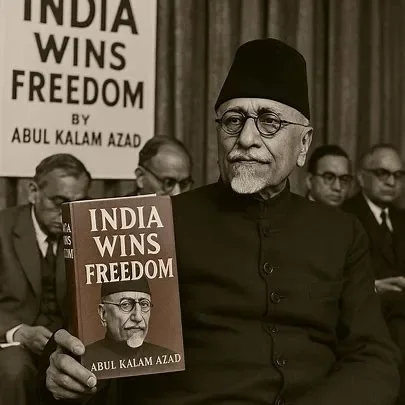
Sepia depiction of Maulana Abul Kalam Azad holding a copy of the book India Wins Freedom, with a placard bearing the title behind him.
DepictionAn artistic depiction referencing India Wins Freedom, not a documentary photograph. Included as illustration only.

The principal work

India Wins Freedom

Azad’s account of the independence struggle, dictated in his last years and published after his death. It is indispensable, partisan, and contested — sometimes on the same page.

The book was published by Orient Longmans in 1959, the year after Azad died. It covers the period from the 1930s to independence from the vantage of someone who was Congress president through the war, Quit India and the Cabinet Mission — which makes it one of the most important first-hand sources on the constitutional endgame of British rule.

It also has an unusual publication history. About thirty pages of the text, dealing with matters Azad considered too personal for immediate publication, were withheld and deposited under sealed cover in the National Library in Calcutta and the National Archives in New Delhi, to be released thirty years after his death. Following a direction of the Delhi High Court in 1988, those pages were handed over and a complete edition was published that year.

Historians use the book extensively and read it critically. Azad wrote with knowledge of how things had turned out and with firm views about his colleagues’ conduct during the negotiations; other participants disputed parts of his account. Both facts are worth knowing before opening it.

First published
1959, Orient Longmans
Complete edition
1988, after the sealed pages were released
Form
Autobiographical narrative of the freedom struggle
Categories

A body of work in four registers.

  • Autobiographical

    His own account of the political events he took part in — principally India Wins Freedom.

  • Letters & literary prose

    Above all Ghubar-e-Khatir, the letters written during his imprisonment at Ahmednagar Fort.

  • Religious & philosophical

    Quranic commentary and related scholarship, including Tarjuman-ul-Quran and Tazkirah.

  • Journalism & speeches

    The weekly essays of Al-Hilal and Al-Balagh, and his presidential addresses and public speeches.

Principal works

Ghubar-e-Khatir

Letters · Urdu · written 1942–46

A collection of letters written during Azad’s imprisonment at Ahmednagar Fort between 1942 and 1946, addressed to a friend and never posted. The subjects are largely not political: music, memory, language, the natural world, solitude, the correct making of tea.

It is widely regarded as one of the finest works of twentieth-century Urdu prose, and it is the book to read if you want to understand Azad as a writer rather than as a politician. Written by a man in indefinite detention with no certainty of release, its refusal to be about imprisonment is itself the point.

Tarjuman-ul-Quran

Quranic commentary · Urdu

Azad’s translation of and commentary on the Quran, and the principal work of his religious scholarship. It reflects the intellectual position he had arrived at as a young man: that a tradition is best served by being examined rather than insulated, and that religious and rational inquiry are not opposed.

The work was composed over a long period and published in parts. Readers seeking specific bibliographic details of a particular edition should consult a library catalogue; this site does not reproduce publication data it cannot verify.

Tazkirah

Autobiographical & reflective · Urdu

An early work combining autobiographical material with reflection on his family background and intellectual formation. It belongs to the period before his political career and is of most interest to readers who want to understand how he came to the positions he later held.

Al-Hilal & Al-Balagh

Journalism · Urdu weeklies · 1912–16

Azad’s weekly essays for the two papers he edited constitute a substantial body of political writing in their own right, and they are where his argument for Indian nationalism and Hindu-Muslim cooperation was first made at length.

Digitised runs of both papers are held by Indian university and national library collections, and are the place to go for the primary texts.

The story of both papers

Speeches & presidential addresses

Political oratory · Urdu & English translations

Two texts stand out. The presidential address to the Indian National Congress at Ramgarh in 1940 is the fullest statement of his case for a single Indian nationality, and the source of the passages most often quoted from him. The address at the Jama Masjid in Delhi on 23 October 1947 is his appeal to Indian Muslims after Partition.

English translations of both are widely reproduced and are the basis for the quotations used on this site. Collections of his speeches and writings have been published in India in several editions.

Books about Maulana Azad

Secondary literature

There is a substantial scholarly literature on Azad in English and Urdu: political biographies, studies of his religious thought, work on Al-Hilal and the Urdu press, and analyses of his role in the Partition negotiations. Historians differ, sometimes sharply, in their assessments.

This site does not publish a recommended reading list with authors, publishers and dates, because doing so responsibly requires bibliographic verification of every entry. Readers looking for scholarship should begin with a university library catalogue or the collections of the institutions Azad himself helped establish.

On bibliographic accuracy

No ISBNs, publishers, editions or publication dates appear on this page unless they could be verified against a reliable record. Where only a title and its general character are established, that is all that is stated. This is deliberate: an invented catalogue entry is more damaging to a reader than a missing one, because it looks like information.

Reading him today

Where to start

For the politics: India Wins Freedom, read alongside at least one modern historical account of the same period, so that the partisan element is visible.

For the writer: Ghubar-e-Khatir, in Urdu if you can, in translation if you cannot. It is the book that explains why people who disagreed with everything he said still read him.

For the argument: the 1940 Ramgarh presidential address, which is short, available in English translation, and states his position on Indian nationality more clearly than any summary of it.

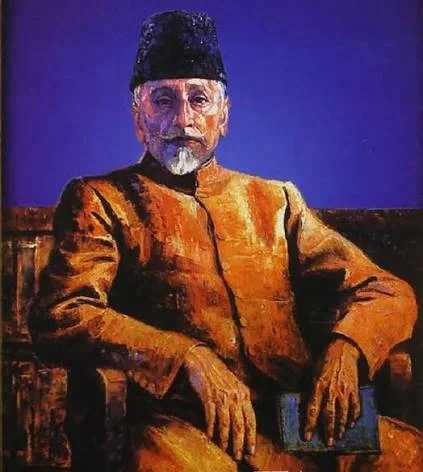
Oil-painted portrait of Maulana Abul Kalam Azad in an ochre sherwani against a deep blue background, one hand resting on a book.
PaintingPainted portrait of Maulana Azad. Artist and date not recorded in the available source.