Maulana Abul Kalam Azad 1888 — 1958

Education

India’s First Education Minister

He inherited an education system built to serve an empire and was asked to turn it into the education system of a democracy. He had eleven years.

In office
15 August 1947 — 22 February 1958
Portfolio
Education (later also Natural Resources & Scientific Research)
Chapter
08 of 08

The brief

15 Aug 1947 — 22 Feb 1958

The job was to convert an education system designed to produce clerks for an empire into one capable of producing the citizens of a republic.

Maulana Abul Kalam Azad took office as independent India’s first Minister of Education on 15 August 1947 and held the portfolio — later widened to include natural resources and scientific research — until his death on 22 February 1958. Eleven years is a long tenure in any ministry. In a new state, it is long enough to set a direction that outlasts you.

  • 11

    Years in office

    The longest tenure of any Indian education minister, spanning the whole first decade of the republic.

  • 1st

    Education Minister

    The first to hold the portfolio in independent India, from the day of independence itself.

  • 1950

    ICCR founded

    Founding president of the Indian Council for Cultural Relations, established in April 1950.

  • 1953

    UGC inaugurated

    He formally inaugurated the University Grants Commission on 28 December 1953.

Section 01

Education as social transformation

His argument was not that education is good for individuals. It was that a democracy is only as capable as the people who have to run it.

This distinction matters. If education is a private good, the state’s obligation is limited and its interest is charitable. If education is the mechanism by which a self-governing society maintains its own capacity to govern, then providing it is a condition of the state’s legitimacy rather than a service it happens to offer.

Azad argued the second position, consistently, in a country where the practical obstacles were enormous. Government sources record his emphasis throughout on free and compulsory education for children, on the education of women and girls, on modern science, on technical education, and on the quality of teaching as a matter of national consequence.

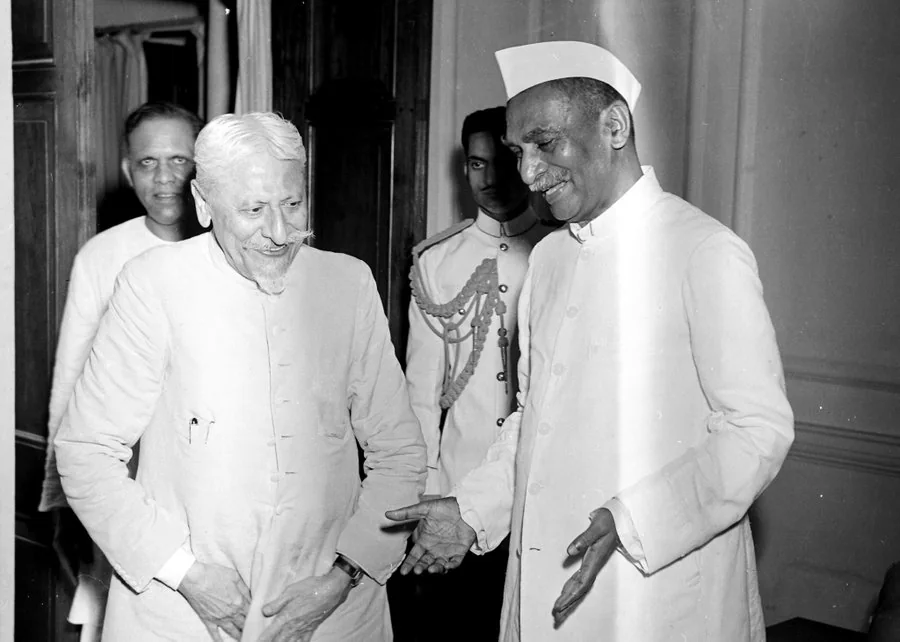
Maulana Abul Kalam Azad in conversation with Dr Rajendra Prasad, both in white, photographed indoors.
ArchiveAzad with Dr Rajendra Prasad. Occasion and date not recorded in the available source.

The challenge of a new nation

The scale of the problem in 1947 is easy to state and hard to imagine. Literacy across the country was low. The great majority of children were not in school, and the great majority of those who were, were boys. Teacher training was thin. School buildings, in much of rural India, did not exist.

Higher education was small and concentrated. There was no national machinery for funding universities or for maintaining standards between them. There were very few institutions capable of producing engineers, applied scientists or research scholars at anything like the scale a modern economy would require, and no coordinated system for planning technical education across the country.

Against that, the new government had almost no money, a refugee crisis, an unfinished constitution and a partitioned administration. Every decision about education in this period was a decision about what to do first.
Universal access

Azad’s first commitment was to universal primary education: free and compulsory schooling for children, treated as an obligation of the state rather than an aspiration. Government sources record this as a consistent theme of his ministry.

The principle was written into the constitutional settlement he helped bring about. The Constitution adopted in 1949 directed the state to provide free and compulsory education for all children up to the age of fourteen, within ten years. That deadline was not met — it took India considerably longer, and the right to education was not made enforceable until 2009 — but the direction was set in the first decade, and Azad was among those who set it.

It is worth being honest about the gap between commitment and delivery. Azad himself was, by all accounts, impatient about it. The historical significance of the period is not that the problem was solved but that the obligation was accepted, publicly and at the highest level, as belonging to the state.

Women and education

Government sources record Azad’s specific and repeated emphasis on the education of women and girls. In the India of the late 1940s this was neither uncontroversial nor cheap: female literacy was far below male literacy, girls left school earlier where they attended at all, and in many regions the social obstacles were more binding than the financial ones.

The way he framed the argument is the part worth preserving. Girls’ education was not presented as a welfare measure or a matter of fairness alone, but as a question of national capacity: a country that educates half its population has decided, in advance, to operate at half strength. Committees and commissions established during this period took up the question of women’s education as part of the wider reconstruction of the school and university system.

Science and modern knowledge

Azad’s portfolio was expanded to include natural resources and scientific research, which tells you where the government’s priorities lay and where his own did. He argued for scientific education not as a specialism for a few but as part of what a general education ought to contain — a disposition towards evidence rather than a body of technical facts.

That position followed directly from his own intellectual history. A scholar who had taught himself mathematics and the natural sciences alongside a classical religious curriculum was unlikely to accept that the two were in competition, and he did not. His public argument was consistently that scientific inquiry and cultural inheritance are complementary, and that a country needs both to be confident in either.

Technical and higher education

The decisive institutional developments of Azad’s tenure were in technical and higher education. The first Indian Institute of Technology was established at Kharagpur in 1951, following the recommendation of a committee appointed to consider higher technical education; it became the model for the network that followed. The All India Council for Technical Education, which had been set up as an advisory body in 1945, operated within his ministry through this period as technical education expanded.

In higher education more broadly, the central problem was coordination: universities were multiplying without a national mechanism for funding them or maintaining standards between them. The University Grants Commission was created to solve it. Azad formally inaugurated the UGC on 28 December 1953; it was given statutory footing by an Act of Parliament in 1956 and remains the central body in Indian higher education.

All the institutions, with dates

Building institutions

Azad’s ministry also built the cultural infrastructure of the new republic. Three national academies were established between 1952 and 1954 — for the performing arts, for letters, and for the visual arts — giving each field a standing national body. The Indian Council for Cultural Relations was founded in April 1950 with Azad as its first president, to manage India’s cultural relations with other countries.

Placing culture inside the education portfolio was itself an argument. It said that a country’s literature, music, dance, theatre and art are part of its educational endowment rather than decoration, and that they need public support on the same footing as laboratories and universities.

Education for democracy

Underneath all of it sat a single claim, which is the reason Azad’s name is attached to India’s education debate seventy years later. A democracy asks its citizens to make judgements — about candidates, arguments, evidence and each other — and the quality of those judgements is a function of how well the citizens have been taught to make them.

On that view, education policy is not one department’s business among many. It is the maintenance schedule for the political system itself. Azad said so repeatedly, and he acted on it for eleven years in a ministry that had less money than it needed and more to do than it could manage.

He died in office on 22 February 1958. Since 2008 his birth anniversary, 11 November, has been observed across India as National Education Day.

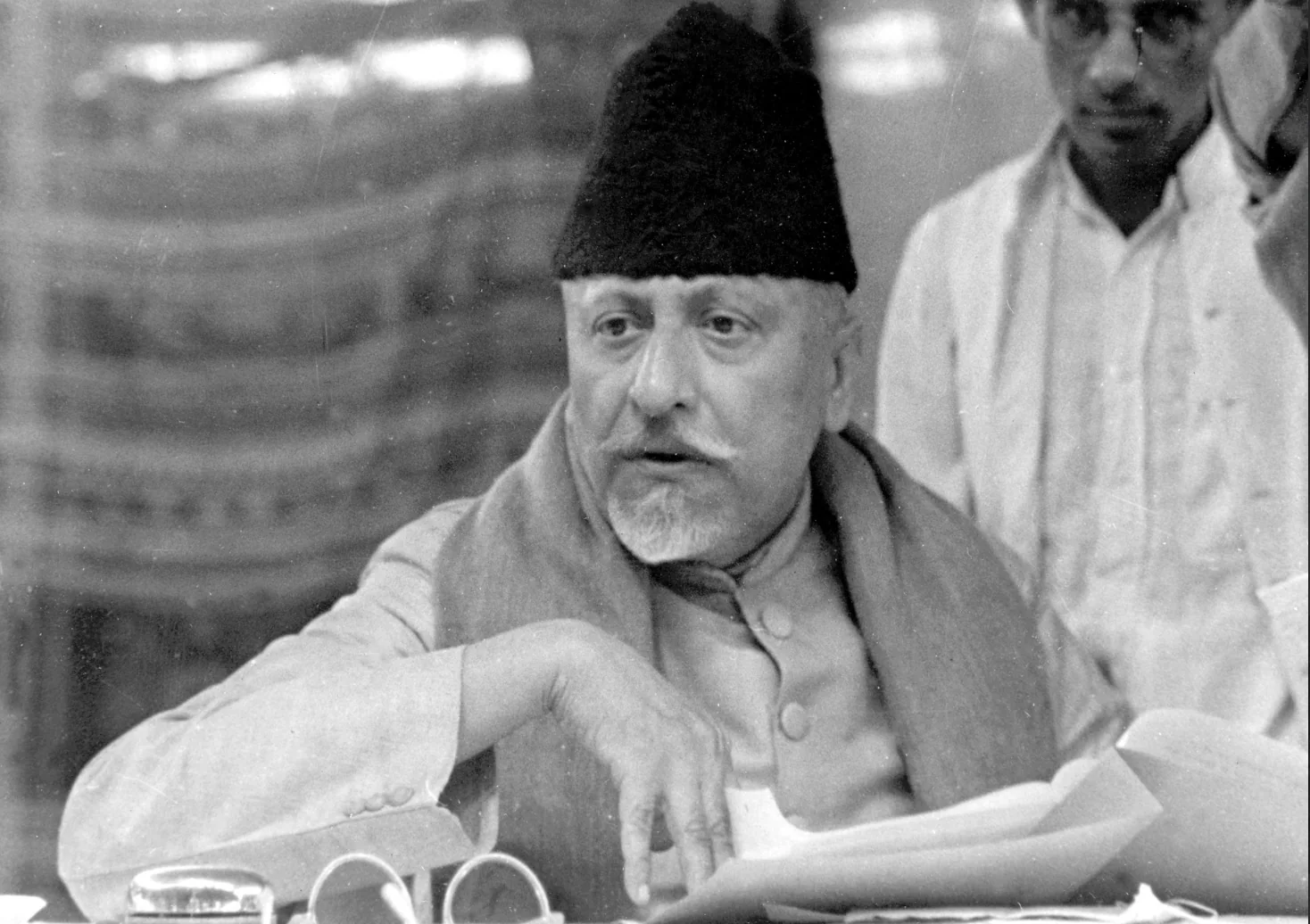
Maulana Abul Kalam Azad at a table covered with papers, speaking, with officials standing behind him.
ArchiveAzad at work among papers. Occasion and date not recorded in the available source.
A note on attribution Education policy in the first decade of the republic was made by committees, commissions, ministries and legislatures, not by one person. This page describes the priorities Azad pressed and the institutions established during his tenure, using the wording the record supports. Where an institution was established before 1947, or where his role was to inaugurate or preside rather than to found, the page says so.